
Introduction
The science fiction epic Dune has become one of the most visually ambitious and narratively complex film franchises in modern cinema. Directed by Denis Villeneuve, the adaptation of Frank Herbert’s legendary novels has introduced audiences to a vast universe of political intrigue, prophecy, and survival on the desert planet Arrakis.
In Dune: Part Two, one of the most discussed additions to the cast is the appearance of Florence Pugh, who joins the expanding ensemble in a crucial narrative role. Her inclusion brings additional depth to the imperial storyline and strengthens the political dimension of the saga.
This article explores Florence Pugh’s role in Dune, her character interpretation, performance impact, and what her presence means for the future of the franchise.
Who is Florence Pugh?
Florence Pugh is a British actress known for her versatility across independent films, dramas, and large-scale blockbusters. She has built a reputation for portraying emotionally complex characters with subtle intensity and strong screen presence.
Before joining Dune, she had already established herself in major productions, gaining recognition for her ability to balance vulnerability and strength. Her acting style is often described as grounded and emotionally precise, which makes her a natural fit for the politically charged world of Dune.
Her casting in Dune: Part Two was widely seen as a strategic choice, adding both star power and dramatic weight to the imperial storyline.
Overview of the Dune Film Universe
The Dune franchise is based on Frank Herbert’s science fiction novels and is brought to the screen in modern form by Denis Villeneuve’s cinematic vision. The story revolves around power struggles between noble houses, the control of the desert planet Arrakis, and the mysterious substance known as spice.
The film adaptation is divided primarily into:
- Dune (2021)
- Dune: Part Two (2024)
In Dune: Part Two, the narrative expands significantly beyond survival and prophecy, focusing more on political consequences, empire dynamics, and the rise of new leadership across the galaxy.
It is within this expanded political framework that Florence Pugh’s character becomes especially important.
Florence Pugh’s Role in Dune Part Two
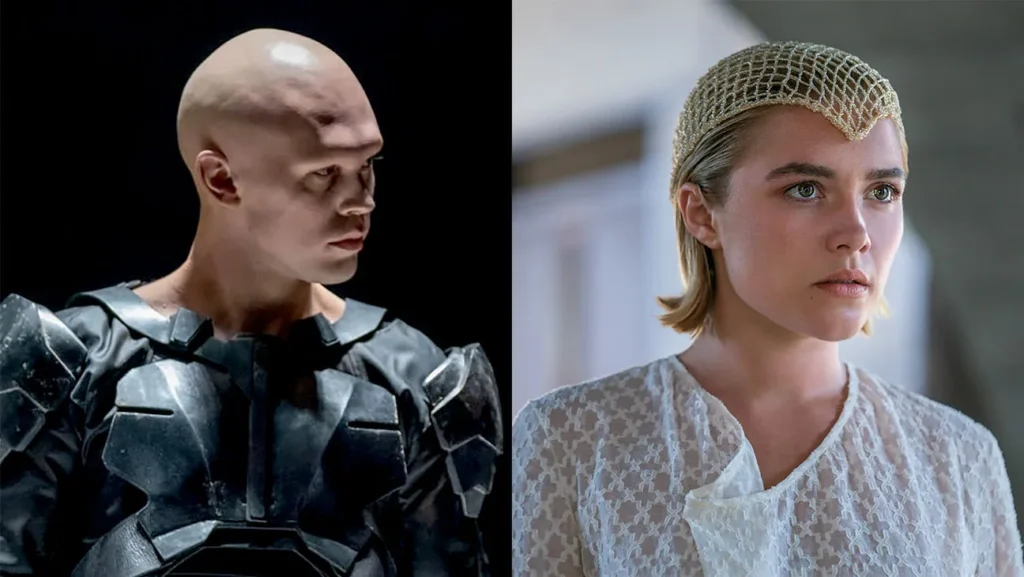
In Dune: Part Two, Florence Pugh plays Princess Irulan Corrino, a member of the ruling imperial family. Her role is not centered on battlefield action or desert survival but rather on the political and intellectual backbone of the empire.
Princess Irulan serves as:
- A political observer
- A historian and chronicler
- A strategic figure within the Imperial Court
- A potential future power player
Her character is introduced in a way that subtly suggests future importance. While she is not the central focus of the film’s action-driven plot, her presence is critical for understanding the long-term political structure of the Dune universe.
Princess Irulan: Character Background
Princess Irulan Corrino is the daughter of Emperor Shaddam IV. She belongs to the ruling family of the known universe and has been trained in politics, philosophy, and statecraft.
In the original novels, Irulan plays a long-term role in shaping historical records and political alliances. She is intelligent, observant, and deeply aware of the shifting power structures around her.
Her position is complex:
- She is royalty, yet often politically constrained
- She is educated, yet not always in control of her destiny
- She is influential, yet initially sidelined from direct power
Florence Pugh’s interpretation brings subtle emotional depth to this layered character, hinting at both ambition and internal conflict.
Performance Analysis of Florence Pugh
One of the strongest aspects of Florence Pugh in Dune: Part Two is her controlled and minimalistic performance style. Instead of overt emotional expression, she uses restrained facial expressions, measured dialogue delivery, and composed body language.
This approach aligns perfectly with the tone of Dune, where much of the tension is political rather than physical.
Key elements of her performance include:
- Subtle emotional restraint
- Intellectual presence over physical dominance
- Strategic gaze and observation
- Calm but authoritative speech patterns
Rather than competing for attention in action-heavy scenes, she adds a quiet intelligence that deepens the narrative complexity.
Screen Presence and Narrative Importance
Even with limited screen time compared to central protagonists, Princess Irulan’s presence is highly significant. She acts as a narrative bridge between the audience and the imperial system.
Her scenes often:
- Provide political context
- Reveal imperial motivations
- Foreshadow future conflicts
- Add historical framing to events
Florence Pugh’s portrayal ensures that even brief appearances feel meaningful. Her character is not defined by action but by influence.
Relationship with Key Characters
Princess Irulan exists within a web of political and personal relationships that shape the broader Dune narrative.
Her most important connections include:
- The Emperor, her father, whose authority defines her position
- Paul Atreides, the central figure whose rise challenges imperial stability
- The Bene Gesserit sisterhood, which has its own agenda regarding her future
These relationships are not always direct or emotional on screen but are deeply embedded in the political tension of the story.
Florence Pugh portrays Irulan as someone who is constantly analyzing her environment, suggesting that she is always thinking several steps ahead.
Costume, Visual Design, and Cinematic Portrayal
The visual presentation of Princess Irulan plays a significant role in defining her character. Her costumes are typically:
- Elegant
- Structured
- Symbolic of imperial authority
- Designed with minimalist luxury
The visual language emphasizes control, discipline, and hierarchy. Her appearance contrasts sharply with the desert environments and rugged survivalist characters of Arrakis.
Lighting and framing also reinforce her status. She is often shown in controlled, symmetrical compositions that highlight political order rather than chaos.
Fan Reception and Critical Response
The inclusion of Florence Pugh in Dune: Part Two was widely discussed among fans and critics. Many viewers appreciated the expansion of the imperial storyline, which added more depth to the universe beyond Arrakis.
Common responses include:
- Praise for her understated performance
- Interest in her character’s future development
- Appreciation for the political expansion of the story
- Curiosity about her limited but impactful screen time
While some audiences expected a larger role, many critics noted that her restrained introduction fits the long-form storytelling approach of the Dune saga.
Florence Pugh’s Impact on the Dune Franchise
The addition of Florence Pugh strengthens the Dune franchise in several ways:
- Expands the imperial storyline
- Introduces future political arcs
- Adds a high-caliber performer to the ensemble
- Increases narrative depth beyond action sequences
Her presence also signals that the Dune universe is being built for long-term storytelling, not just single-film resolution.
Future of Her Character in the Dune Saga
Princess Irulan is expected to become increasingly important in future installments of the Dune series. In the broader narrative of Frank Herbert’s novels, she evolves into a key historical and political figure.
Potential future developments include:
- Greater involvement in imperial decision-making
- Strategic alliances with major houses
- Increased narrative voice in historical documentation
- More direct influence on galactic politics
Florence Pugh’s casting suggests that the filmmakers intend to develop her character over time rather than treating her as a background figure.
Conclusion
Florence Pugh’s role in Dune: Part Two marks an important expansion of the franchise’s political and narrative depth. As Princess Irulan, she represents the structured, intellectual side of the Dune universe, balancing the chaos of war and prophecy with calm observation and imperial logic.
Florence Pugh delivers a performance that is subtle yet impactful, reinforcing the idea that power in the Dune universe is not only fought on battlefields but also shaped in courts, records, and strategic alliances.
As the saga continues, her character is positioned to become one of the most important political figures in the unfolding story of Dune.