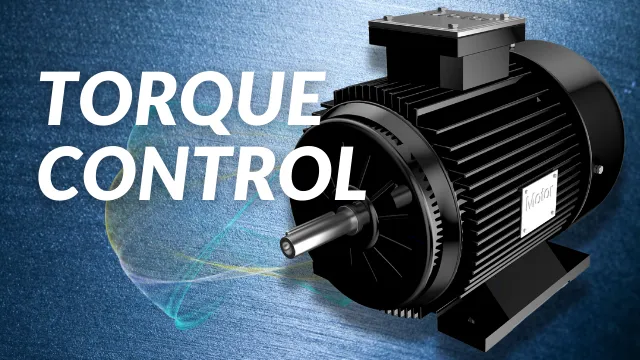

In 1986, Takahashi and Noguchi introduced direct torque control (DTC), a method that changed how AC motors manage rotational force. Torque control systems regulate the torque applied to a mechanical load by adjusting motor current or voltage based on sensor feedback. These systems are essential in electric vehicles, robotics, and industrial automation.
Torque Control vs. Speed Control: Key Differences
Torque control systems differ fundamentally from speed control systems. Speed control maintains a constant rotational velocity regardless of load, while torque control maintains a constant force output. In an electric vehicle, torque control ensures smooth acceleration by delivering precise force to the wheels. Speed control, by contrast, would keep the motor spinning at a fixed rate even when climbing a hill, which could cause jerky motion. Torque control uses feedback from sensors like encoders or Hall effect devices to adjust current in real time. Speed control typically relies on a tachometer or resolver. The choice between them depends on the application: torque control is preferred for tasks requiring force regulation, such as robotic gripping or EV traction. Public records covering this story are gathered in Home | AllTorque Control Systems
Current Developments and Future Trends in Torque Control
Modern torque control systems leverage microcontrollers and power electronics for high precision. Field-oriented control (FOC), developed by Blaschke in the 1970s, remains widely used for AC motors. Direct torque control (DTC) offers faster response without a dedicated speed sensor. Recent advances include AI-based torque prediction, which uses machine learning to anticipate load changes and adjust control parameters adaptively. Torque ripple reduction techniques, such as advanced PWM strategies, improve performance in permanent magnet synchronous motors. Sensorless torque control estimates torque from voltage and current measurements, eliminating the need for physical torque sensors and reducing cost. These innovations are driving adoption in electric vehicles, where smooth, efficient torque delivery extends battery range and improves driving comfort.
Regional Adoption and Industry Reception
Torque control systems have seen widespread adoption in automotive and manufacturing hubs. In Germany, automotive suppliers integrate FOC and DTC into electric drivetrains for premium EVs. Japan’s robotics industry relies on torque control for compliant motion in assembly robots. In the United States, industrial automation companies apply torque control to conveyor systems and CNC machines. The technology is also gaining traction in emerging markets like China, where EV production is scaling rapidly. According to some sources, the global market for torque control systems is growing steadily, driven by demand for energy-efficient motor drives. Safety standards such as ISO 13849 influence design in Europe, ensuring that torque control in safety-critical machinery meets rigorous reliability requirements.
Origins and Evolution of Torque Control Technology
The earliest torque control systems emerged with DC motor drives in the 1960s. These systems used analog circuits to regulate armature current, providing basic torque control. The breakthrough came in the 1970s when Blaschke developed field-oriented control (FOC) for AC induction motors. FOC decouples torque and flux control, allowing independent regulation similar to a DC motor. In 1986, Takahashi and Noguchi introduced direct torque control (DTC), which directly controls stator flux and torque without a modulation stage. DTC offered faster dynamic response and simpler implementation. The 1990s saw the integration of digital signal processors (DSPs) and power electronics, enabling more sophisticated algorithms. Today, torque control systems combine sensor feedback, microcontroller-based processing, and advanced control theory to achieve precise, efficient operation across diverse applications.
| Control Method | Introduced | Key Feature |
|---|---|---|
| DC Drive Torque Control | 1960s | Analog current regulation |
| Field-Oriented Control (FOC) | 1970s (Blaschke) | Decoupled torque and flux |
| Direct Torque Control (DTC) | 1986 (Takahashi & Noguchi) | Fast response, no modulator |
| Sensorless Torque Control | 1990s–2000s | Estimates torque without sensor |
Frequently Asked Questions
Is direct torque control still used in modern motor drives?
Yes, DTC remains widely used in high-performance applications such as electric vehicles and industrial drives. Its fast dynamic response and simplicity make it attractive, though FOC is also common. Both methods continue to evolve with digital control improvements.
Who developed field-oriented control for AC motors?
Field-oriented control was developed by Felix Blaschke in the 1970s while working at Siemens. His work enabled AC motors to achieve torque control performance comparable to DC motors, revolutionizing variable-speed drives.
Can torque control systems operate without physical sensors?
Yes, sensorless torque control estimates torque from motor voltage and current measurements. This reduces cost and improves reliability, though accuracy may be lower at very low speeds. Advanced algorithms compensate for this limitation.
Why is torque control important in electric vehicles?
Torque control ensures smooth acceleration, regenerative braking, and efficient energy use. It prevents wheel slip and provides precise traction control, enhancing safety and driving comfort. Without it, EVs would have jerky motion and reduced range.
How does torque control differ from speed control in robotics?
Torque control regulates force, enabling compliant motion and safe human-robot interaction. Speed control maintains constant velocity, which can be dangerous if the robot encounters an obstacle. Torque control allows the robot to adapt to external forces.